How Powder Activated Carbon is Made | Density | Particle Size | MSDS | Cost
Powder Activated Carbon (PAC) is made through a series of steps that transform raw carbon-rich materials—like wood, coal, or coconut shells—into a fine, porous powder capable of adsorbing a wide range of contaminants.
As wood based powder activated carbon is the primary raw material for PAC, here’s a breakdown of how wood-based PAC is made:
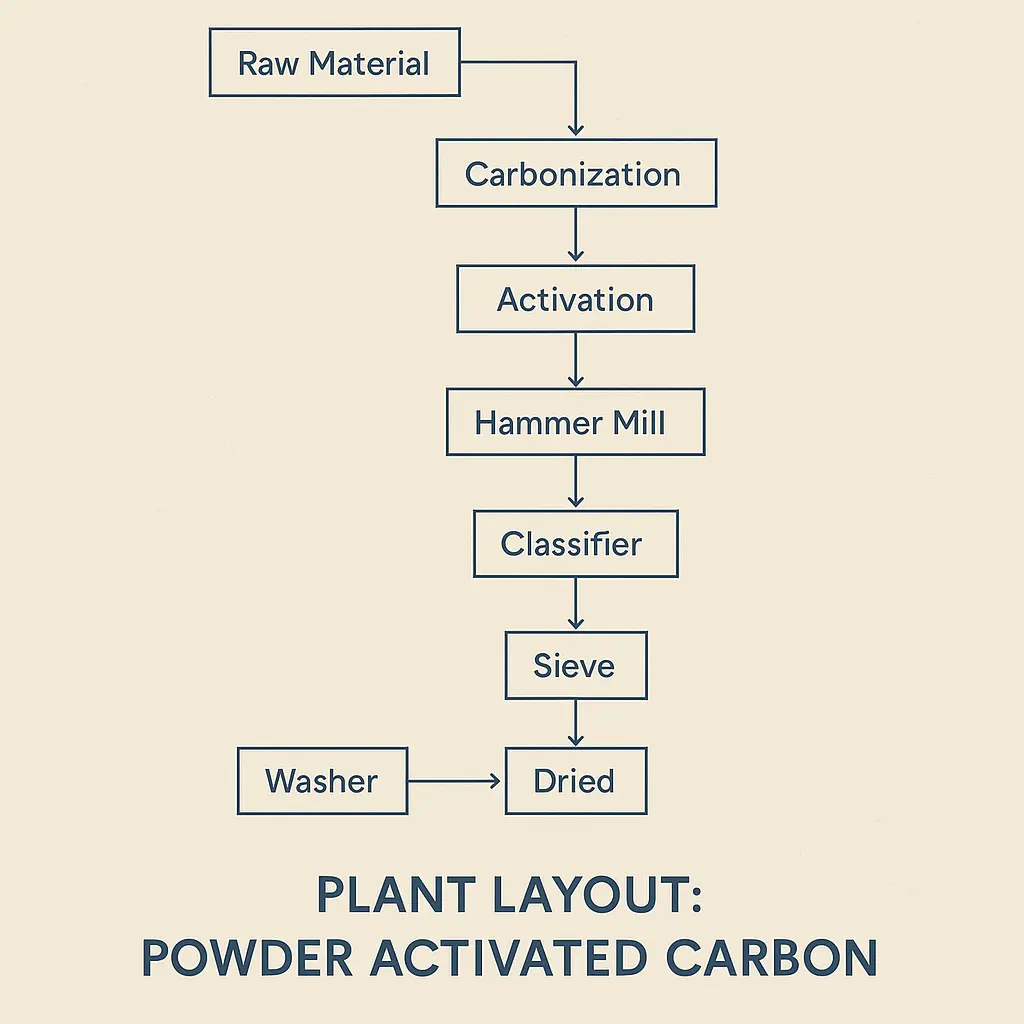
Step by Step Guide to Manufacture Powder Activated Carbon
Selection of Raw Material
- High-lignin woods such as babul, poplar, or pine are often used. Alkaline Carbon used Babul Wood.
- The wood must be clean, dry, and low in resin or sap content.
Carbonization (Making Charcoal)
- Wood is heated in an oxygen-limited environment (pyrolysis) at 400–700°C.
- Volatile compounds are driven off, leaving behind charcoal (carbon-rich residue).
- Activation
This is the key process that creates the high surface area and pore structure.
Two main activation methods:
Steam Activation (Most common for wood-based PAC)
- Charcoal is heated to 800–1000°C in the presence of superheated steam. Alkaline Carbon makes wood PAC from Steam Activation.
- Steam opens up pores by partial gasification of carbon.
Chemical Activation
- Charcoal is impregnated with chemicals like phosphoric acid (H₃PO₄) or zinc chloride (ZnCl₂).
- Heated to 450–600°C, then washed to remove chemicals.
- More common for specialty PAC grades.
Grinding
- The activated carbon is ground to a fine powder.
- Typical particle size: 80–325 mesh (45–180 microns).
- The finer the powder, the faster the adsorption rate.
Sieving and Classification
- The powder is passed through sieves to achieve uniform particle size.
- Oversized particles are re-ground.
Washing and Drying
- PAC is washed in acids to remove residual ash, iron content and other impurities if highly purified carbon is desired for the application like APIs & Pharma .
- Then dried to reduce moisture content to <5–10%.
Packaging
- Final PAC is packed in moisture-proof bags (often 25 kg or 500 kg bulk bags).
- Labeled by grade, iodine number, mesh size, and moisture content.
Quality Control Parameters
Material Safety Data Sheet of Powder Activated Carbon
The MSDS (Material Safety Data Sheet)—also known as SDS (Safety Data Sheet)—for Powder Activated Carbon (PAC) is a standardized document that outlines hazards, handling precautions, storage guidelines, and emergency procedures for the material.
You can download the MSDS for wood based powder activated carbon below
Price of Powder Activated Carbon
Hope it was that simple to find the princes of powder activated carbon on the internet. There are multiple factors to be considered based on your application to get the right powder activated carbon price
Factors Influencing PAC Price
Grade and Mesh Size — Higher purity, low ash, high iodine value, or fine mesh (e.g. 200–325 mesh) often cost more. It is important to understand the requirement first and then decide on the right price in comparison to the quality.
Minimum Order Quantity (MOQ) — Prices drop significantly when ordering ≥10 Tons. The bigger the order quantity the lesser the price as the manufacturer is able to negotiate better pricing from the vendors.
Packaging & Handling — Bulk bags vs. 25 Kg regular bags; Bulk bags generally is little costly but is easy to handle with forklift and does not require human labor which makes the process of handling easy and fast.
Location — The nearer the location of the manufacturer to the port, better the transport facility and cheaper the cost of transport. Alkaline Carbon is located within 100 Km from Mundra Port, Gujarat, India.
So if you are looking to get the best price for your powder activated carbon requirement, you can just call/WhatsApp Alkaline Carbon on the above and below given number.
Feel free to contact us over email as well, we will reply within 24 hours on working days.